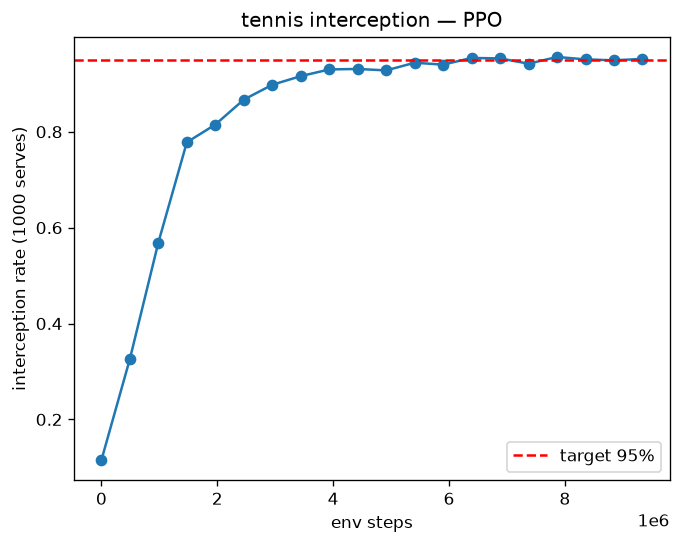
I played NCAA D1 tennis. The first thing every coach teaches is not the swing — it's being where the ball will land. So when I set out to train an RL agent to play tennis in Brax, Phase 1 was that skill and nothing else: 95% of random serves intercepted, or it doesn't count.
Result: 95.2% over 1000 serves. Stock PPO, 9.3M env steps, twenty minutes on a laptop CPU. The interesting part is the three things that broke before any learning happened.
RL projects die from environment-engineering scope creep, so the env is deliberately minimal: a court, a served ball, and a paddle — an actuated box sliding in x/y. No humanoid, no arm, no pixels. Ten numbers in, two out.
The reward carries the coaching insight directly: each step, the penalty is the distance from the paddle to the ball's predicted landing point — closed-form ballistics, re-predicted every step so bounces self-correct. Not distance-to-ball. Distance-to-where-the-ball-will-be. Split-step, read, move.
The backend that couldn't bounce. My spec required a bounce-fidelity
smoke test before committing to a physics backend. Good thing: the
positional backend ignores restitution entirely — a ball dropped from 1m
never leaves the floor. Disqualified by a 40-line script.
The solver that broke conservation of energy. Tuning MJX restitution:
contact dampratio 0.3 rebounds 19%, 0.15 rebounds 33% — and 0.1 rebounds
190%. The 1m drop bounces to 1.9m; at 0.05, to 37m. There's a cliff
where the solver starts injecting energy, and it sits just past the setting
you want. The operating point and the "never below 0.15" rule are an ADR
now.
The trainer that outlived its dependency. brax 0.14's PPO crashes on
jax ≥ 0.11 — jax.device_put_replicated is gone. The physics runs; only
training explodes. Phase 0 existed to validate the loop before any custom
code, and it caught exactly this.
Env bugs masquerade as RL mysteries, so the env has unit tests: serve-cone
distribution, both termination paths, reward-is-higher-under-the-landing-
point, landing math against analytic cases. They paid off on day one —
brax's training wrappers inject keys into the env's metrics dict, which
surfaces as an opaque pytree error unless step updates metrics in place.
Five minutes with a failing test; a lost evening without one.
Per-term reward components are logged from day one, because Phase 2's risk register says reward hacking shows up in curves before it shows up in gifs. (It did. Three times. That's Part 2.)
Random policy: 11.5%. Steep climb to ~4M steps, then a stable 94–95.6%
plateau. The metric rides the evaluator itself — the env emits
interception only on the contact step, so the episode-summed metric is
the interception rate over 1000 fresh serves.
Next: Part 2 — the net goes up, and the agent starts cheating.
Built inside a personal agentic flywheel. The repo is jamesponwith/brax-tennis-rl.