Part 2 ended with a paddle that returns 71.7% of serves. Part 3 puts a second paddle on the far baseline and asks the only question left: can two of them keep a point alive?
Answer: yes, and each generation rallies longer than the last. But the best bug of the whole project came first, and it beat every probe I had.
The plan was a curriculum: take the flat-face champion, surgically expand its network for a tilt-hinge wrist — new observation rows and action column initialized to zero, so step one plays identically — and fine-tune. The surgery verified perfectly offline: 73% returns, champion-level.
Training evals: 0.4%. Random-policy territory, from a 71.7% warm start.
The forensics chain, each layer verified before the next: the surgery was correct (73% offline). The restore path was correct (params round-tripped through the trainer still scored 75%). The evaluator was honest (a flat control scored 69%). Per-step action distributions were identical between deterministic and stochastic modes. And yet: deterministic eval 68%, stochastic eval 0.4%.
The action trace ended the mystery. Under stochastic control, the paddle was commanded at 6.4 m/s in x — and moved ten centimeters in 1.2 seconds. Jammed. The paddle box sat exactly flush on the court; the tilt hinge's micro-pitch under jittery sampled actions dug its bottom edge into the plane, and floor friction locked the slides. Deterministic motion is smooth and never digs — which is why every deterministic probe sailed through while sampling collapsed. The paddle's own physics was the adversary.
The fix was two centimeters: float the box off the court. The warm start immediately evaluated at 70.3%. That jam had been silently taxing every phase of the project.
With the physics honest, the tilt fine-tune ran clean — and produced my favorite kind of result: a split decision. Return rate: 67.5%, below the 71.7% flat baseline. Episode reward: up two points. The wrist wasn't returning more balls; it was placing the ones it returned closer to the target. Aim, not consistency. The flat face stays the workhorse, and the spec's "flat-through-lob control" line gets an honest asterisk.
Self-play needed no new network and no new tricks. The court is symmetric, so one policy can play both ends: the far paddle is driven inside the env by a frozen copy reading mirrored observations — y and vy negated, so the opponent believes it is the near paddle. The learner keeps Part 2's exact interface, which means the champion warm-starts with zero surgery. Rally length rides the evaluator the same way interception did: the metric fires only on net crossings, so the episode sum is the rally.
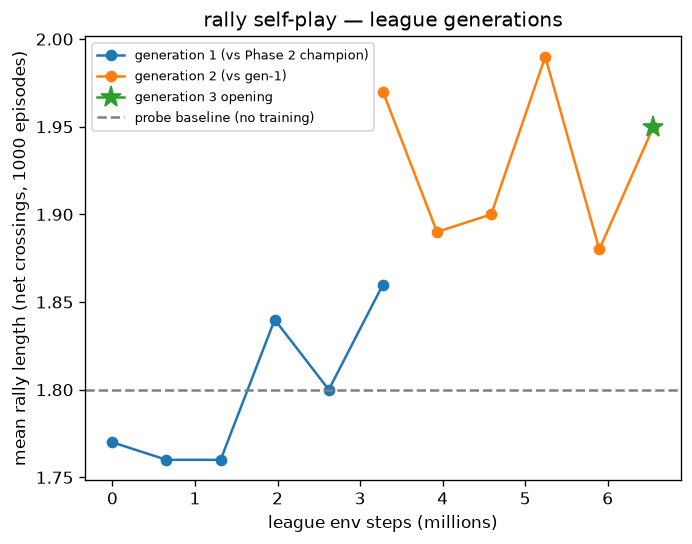
Probe before training, as always: two frozen champions already rally — 1.80 mean crossings, max 5, a returned return in 25 of 40 episodes.
Then the league: train against the champion, freeze the result, train against that. Generation 1 grew rallies 1.77 → 1.86 in-round. Generation 2 opened at 1.97 against its stronger opponent — reproduced across two independent runs — and held ~1.95. The spec's success bar for Phase 3 was "average rally length grows over training." It grows, generation over generation, with a plateau forming near two crossings — the sampled-league upgrade is the documented next rung.
That closes the arc: a box that learned to be where the ball lands, then to put it back, then to keep a point alive against itself. The collegiate tennis player taught an agent to play — and the agent's best lessons were the ones it tried to cheat on.
Built inside a personal agentic flywheel — every fix above landed as a gated PR with tests. The repo is jamesponwith/brax-tennis-rl.